Before the Constellation Lines: How Star Patterns Got Their Names
Learn how star pattern names grew from cultural sky stories, why constellation lines are human-made guides, and how to read both with care.

On a clear evening, a few bright stars can look like a cup, a hunter, or a crooked river, depending on who is pointing. Star pattern names grew from that human impulse to sort the sky into memorable shapes, but the lines on a modern chart are guides, not marks overhead.
Before tracing a familiar outline, remember that naming the stars was never one universal project. Different communities grouped and interpreted the same lights in different ways, and familiar Western constellation pictures are only one inherited map of the heavens.
Patterns Begin With Attention
People notice bright stars, close clusters, and striking arrangements because they are easier to remember than a field of separate points. A pattern can serve as a mental landmark: once someone recognizes it, nearby stars become easier to describe and revisit.
That practical use does not mean every group of stars was designed as a navigation tool or calendar. Stories, ritual life, seasonal knowledge, and local surroundings all shaped what people saw. A pattern’s name can preserve a community’s way of relating to the sky, even when a viewer elsewhere sees a different shape in the same stars.
Try looking before opening a chart. Pick a few conspicuous stars and ask what arrangement they suggest to you. Then compare your idea with a sky map. The contrast can make the map’s cultural choices visible instead of making its lines seem inevitable.
Names Carry Local Stories
Constellation traditions developed across many places and generations. The names and figures used in Greek and later European astronomy became especially influential in printed atlases and modern Western sky maps, but they do not represent every society’s star knowledge.
In other traditions, stars may be understood through figures, relationships, journeys, animals, or seasonal events that do not match familiar constellation boundaries. Some communities also organize knowledge through individual stars or the dark spaces between them, rather than connecting bright points into the same kind of outline.
That variety matters when a chart presents a single label as though it were the sky’s own name. Ask whose naming system the chart uses and what it leaves out. For cultural accounts, seek sources created by the communities whose traditions are being discussed, rather than treating an old atlas as a complete record.
Lines Are Editorial Choices
Star charts draw lines between selected stars to make a figure easier to recognize. Those strokes are conventions, much like borders on a map: they help readers communicate, but they are not physical connections between stars and cannot be seen in the sky itself.
There is no single natural way to connect a set of points. One diagram may emphasize a familiar stick figure; another may connect the same stars differently or leave some unjoined. The underlying stars remain where they are, while the drawn shape changes with the chartmaker’s purpose.
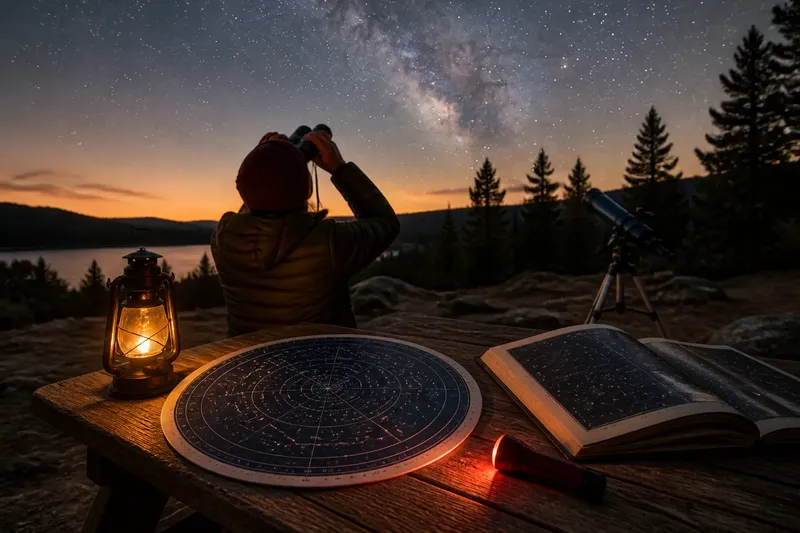
Imagine you are outside with a printed map and a red flashlight. You find three bright stars that match its outline, but the remaining lines seem awkward from your viewing spot. Treat the strokes as prompts, not proof: identify the stars themselves, then decide whether the printed figure helps you remember their arrangement.
Boundaries Differ From Pictures
In modern astronomy, a constellation can mean a defined region of sky, not just the familiar connect-the-dots figure. A star may lie within the official region named for a constellation even if it is not one of the bright points used to draw its popular outline.
This distinction is useful when reading star catalogs or astronomy software. A constellation picture helps with recognition; a boundary divides the sky into named areas. Neither should be confused with a cluster of stars physically close together. Stars that appear near one another from Earth can be at very different distances.
So when a guide says an object is “in” a constellation, it usually identifies its location against that mapped region. It does not necessarily claim that the object belongs to the drawn figure, shares a story with its stars, or sits near them in space.
How Should You Read Star Patterns?
Are constellation lines visible in the sky?
No. The stars appear as points of light, while connecting lines are added to charts and apps to make patterns easier to follow. Turn the screen off or cover the diagram, and the stars remain while the lines disappear.
Why do star charts draw patterns differently?
Chartmakers choose which stars to connect and how to simplify a figure for a particular audience or purpose. Different outlines can represent the same named constellation without changing the stars overhead.
Does every culture use the same constellations?
No. Communities have developed distinct systems of names, stories, and celestial groupings. A chart based on one tradition should not be mistaken for a universal account of how people have understood the sky.
What does it mean when a star is in a constellation?
In current sky maps, the phrase generally means the star’s apparent position falls within that constellation’s mapped region. It does not mean the star is physically connected to the other stars in the picture.
Observe Before You Label
A simple way to make star patterns feel less like fixed diagrams is to separate observation from interpretation. First note the stars you can actually see; then compare their arrangement with a chart’s lines, names, and boundaries. If you use an astronomy app, hide its overlays briefly and look at the unmarked points before switching them back on.
Say you are showing a friend a recognizable pattern from a park bench. You point out its brightest stars without naming it, invite your friend to describe the shape, and then reveal the chart label. The visible result is a conversation about two ways of seeing the same stars, rather than a lesson that the printed outline must be the only right one.
For a fuller view, keep a paper atlas or app beside a notebook and record which stars served as your anchors. Add the chart’s name and, when available, the cultural source of that name. This small habit preserves the practical value of constellation lines while leaving room for the many human histories that shaped star patterns.
Next time a diagram draws a hunter or a vessel overhead, remember that you are looking at a useful act of interpretation. Star pattern names offer a way to share the sky, but the stars themselves remain visible beyond any one chart’s connections.