Binoculars or a Small Telescope for a First Look?
Choose binoculars or a small telescope for a first look by matching portability, handling, and the views you want to explore with your observing habits.
You have a clear evening, a warm jacket, and a few minutes before dinner. If you’re choosing binoculars or a small telescope for a first look, the useful question isn’t which tool is better in general; it’s which one fits the way you want to observe. Binoculars invite a quick, two-eyed view across a broad patch of sky. A small telescope asks for a steadier setup and rewards you with a closer look at a smaller target.
Start with your observing style
Think about where you’re likely to use the instrument and what a satisfying session looks like. If you want to step outside, scan casually, and be back indoors before the kettle boils, binoculars are usually the easier match. They’re compact, familiar to hold, and useful for daytime viewing as well as the night sky.
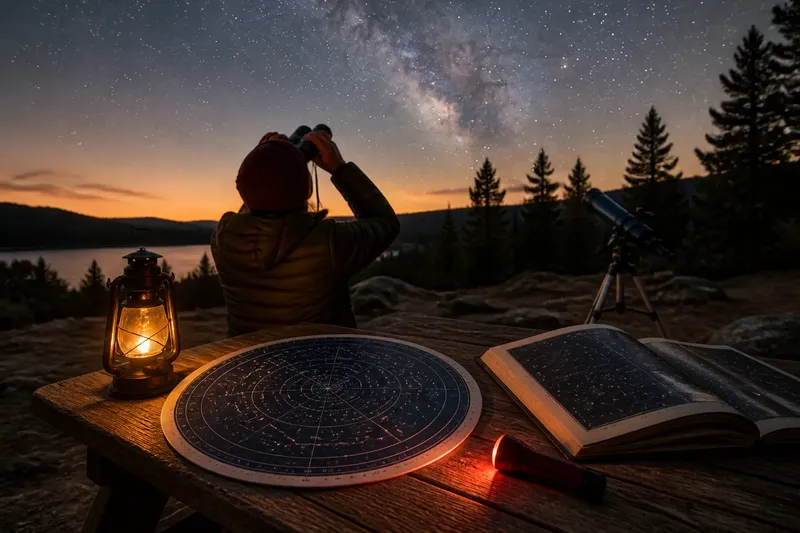
If you enjoy settling in, adjusting a mount, and concentrating on one object at a time, a small telescope may suit you better. Its narrow field of view makes aiming more deliberate, but it can show more detail in a target once you have it centered. Neither choice requires an observatory; both can be used from a backyard, balcony, or open spot away from glaring lights.
Be honest about patience, too. A small telescope isn’t automatically difficult, but it has more parts to carry and align. Binoculars are simpler to pick up, though holding them still while looking high overhead can be tiring. A comfortable observing habit matters more than an impressive-looking instrument that stays in its case.
Choose for easy carrying
For a walk to a park, a camping trip, or a quick look from a porch, binoculars have the portability advantage. They fit in a small bag and don’t usually need a separate support for casual viewing. Their broad view can also make it easier to take in a star cluster or sweep through a rich stretch of the Milky Way.
A small telescope can still be portable, especially if its tube and mount are designed to travel together, but the full kit takes more space. A tripod or tabletop mount, eyepieces, and protective case all count as part of the load. Before choosing, picture carrying everything from your car to the place you actually plan to observe—not just lifting the tube in a store.
Consider storage at home as well. Binoculars can be ready on a shelf near the door, while a telescope may need a stable place for its mount and accessories. If setup friction is likely to keep you indoors, the smaller, simpler instrument may provide more real observing time.
Match the view you want
Binoculars show the sky in a more natural, wide-angle way. Seeing with both eyes can feel relaxed and immersive, and the surrounding stars help you understand where an object sits in the larger scene. This is especially appealing for sweeping star fields, bright open clusters, and the Moon as a whole rather than a close inspection of its surface.
A small telescope narrows the scene and brings a chosen target closer. Depending on the instrument and conditions, you can examine lunar craters and shadows, separate a bright planet from its surroundings, or make a compact deep-sky object easier to distinguish. It won’t turn every faint object into a vivid photograph: visual astronomy is usually subtler, with soft contrast and details that take time to notice.
Magnification is only one part of the experience. A higher-power view can be harder to keep steady and may show less of the sky at once. For a beginner, an easy-to-center target and a comfortable view often matter more than the largest magnification printed on a box.
Sort by your situation
- Choose binoculars for casual, frequent sessions. They’re quick to take outside and suit a person who wants to scan rather than commit to a long setup.
- Choose binoculars for broad star fields. Their wider view keeps more surrounding stars in sight, making the overall pattern of a region part of the experience.
- Choose a small telescope for closer lunar viewing. Its focused, magnified view is better suited to studying the Moon’s surface than seeing the full scene at once.
- Choose a small telescope if you like careful adjustments. Centering an object, changing eyepieces, and keeping the mount steady can be satisfying if you enjoy a hands-on session.
- Choose binoculars if you’ll carry the instrument on foot. A light, compact setup is easier to bring along than a telescope with its mount and accessories.
- Choose a telescope if one target holds your attention. A narrow, closer view makes sense when you’d rather examine a particular object than roam across the sky.
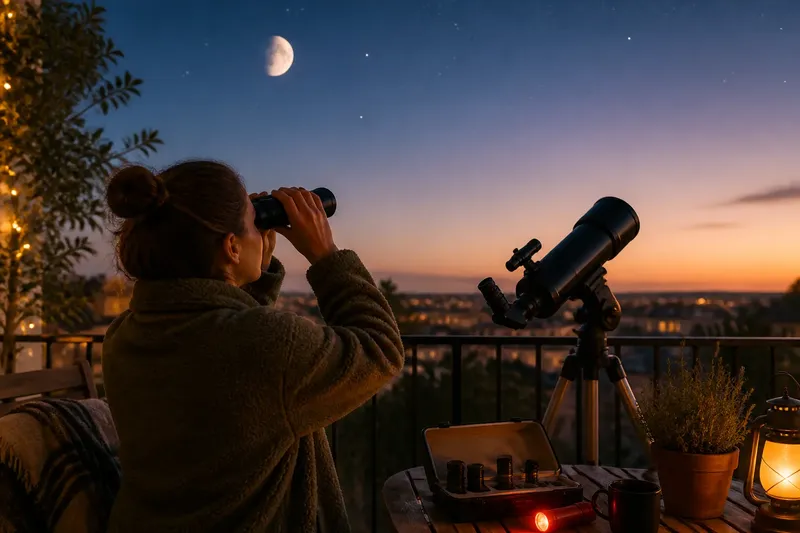
Say you live in an apartment and can observe only from a small balcony. If you want to step out for a brief scan between chores, binoculars are likely the more practical fit; if you have room for a stable mount and enjoy lingering over the Moon, a small telescope may be more rewarding. In either case, the best match is the one you can use comfortably in that space.
Questions about choosing?
Can binoculars show the Moon clearly?
Yes, binoculars can give a clear, attractive view of the Moon and its larger light-and-dark features. A steady grip or a suitable support helps, but binoculars show less fine surface detail than a telescope with useful magnification.
Is a small telescope harder to aim?
Usually, it takes more practice because the narrower view gives you less surrounding sky to guide your aim. A steady mount and a low-power eyepiece can make finding and centering a target less frustrating.
Can one tool work for daytime viewing?
Binoculars are naturally convenient for distant daytime scenery and wildlife, provided you use them as directed and never point them at the Sun. Some telescopes can also be adapted for terrestrial views, though their orientation and setup may feel less intuitive.
Should I choose by magnification?
Don’t make magnification the only deciding factor. A steadier image, a useful field of view, and comfortable handling can make an instrument more enjoyable than a higher-power option that’s difficult to aim.
Plan for comfortable viewing
With binoculars, resting your elbows against a railing or sitting in a chair can reduce arm strain. A simple tripod adapter may help for extended sessions, though it adds another item to carry. For targets high in the sky, choose a position that lets your neck stay relaxed rather than forcing you to lean backward.
A telescope benefits from a stable base and a place where you can sit or stand without bumping the mount. A red flashlight can help you find accessories without flooding your eyes with bright white light. Keep eyepieces in a small case or closed container so they stay organized and protected from dust.
For either instrument, check the maker’s instructions before use, especially for mounting, cleaning, and any solar-viewing equipment. Never look at the Sun through binoculars or a telescope without a purpose-built solar filter correctly fitted as specified by its manufacturer; ordinary sunglasses and improvised filters are not safe substitutes.
Make the first purchase fit
Before buying, try holding binoculars in a store or borrowing a pair from someone you know. Notice whether you can keep the view steady and whether the focus control feels manageable. For a telescope, check that the mount feels stable and that the controls are understandable; a telescope tube without a usable mount isn’t a complete observing setup.
Ask what comes with the instrument, including the mount, eyepieces, caps, and carrying case. Manufacturer instructions determine what’s compatible and how parts should be used, so confirm details there when a choice depends on a label or model. Avoid buying extra accessories until you know what feels limiting during actual sessions.
For many first-time skywatchers, binoculars are the sensible choice when portability, ease, and wide views lead the list. A small telescope fits better when the main goal is a closer look and the setup itself sounds enjoyable. If you remain undecided, borrow binoculars for a casual evening first; that experience can clarify whether you want to roam across the sky or settle in on one target.
Whichever you choose, make the first session modest: pick a comfortable spot, dress for standing still, and begin with an object easy to find. The right instrument isn’t the one with the longest list of features, but the one whose view makes you want to step outside again.