The Brightest Point Is Not Always the Most Interesting
Learn to read a night sky beyond its brightest point by comparing nearby stars, spacing, color, and patterns across a wider patch of sky.
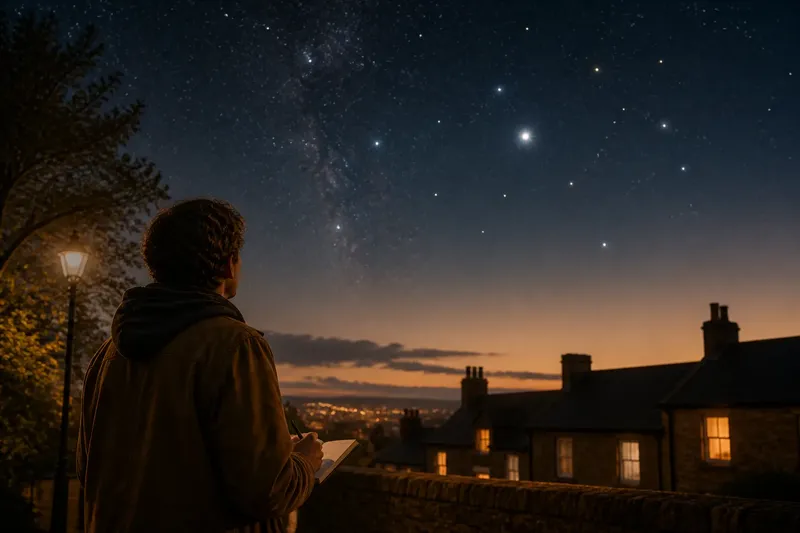
You step outside, glance up, and your eyes land on the brightest point above the rooftops. That first look is useful, but it can also make the rest of the sky feel like background. To read the sky more fully, treat brightness as one clue among several: notice what sits nearby, how points are spaced, and where the pattern changes.
This is a simple observing habit, not a hunt for a rare object. It works from a backyard, a park bench, or a quiet street where you can see a patch of open sky. The aim is to let relationships between objects tell you more than a single standout point can.
Start with your whole view
Before naming anything, pause and let your eyes adjust to the scene. Look at a broad area rather than fixing on one bright point. If you are near a porch light or a bright window, turn away from it when you can; glare makes faint stars harder to notice.
Keep your phone in your pocket for this first pass. A screen can pull your attention into a narrow frame just when you are trying to see the larger arrangement. If you need a light later, use a dim setting and give your eyes time to settle again afterward.
Now ask a few plain questions. Is the bright point isolated, or does it sit among several others? Does one side of the patch look crowded while another seems open? Can you trace a line, curve, or loose cluster without deciding yet what it represents?
Those first impressions are worth keeping, even if you later identify the objects differently. A quick note in a pocket notebook—“bright point above the roof, three fainter points to its left”—records what you actually saw instead of what you expected to see.
Compare brightness nearby
Brightness is relative. A point can appear dominant because its neighbors are faint, not because the surrounding sky is empty. Find two or three nearby stars and compare them with the standout point. Notice whether they are only slightly dimmer or seem to disappear beside it.
Try shifting your gaze a little to the side of a faint star rather than staring directly at it. In low light, the edges of your vision can sometimes register a dim point more readily. This is a viewing technique, not a promise: clouds, haze, eyesight, and nearby lighting all change what you can pick out.
Look for small contrasts, too. A group of similar-looking points may be interrupted by one that appears warmer, cooler, or noticeably brighter. Don’t decide that a color impression is certain on a first glance; low-light vision is not especially good at judging subtle color. Simply note the difference and see whether it remains when you look again.
Trace spacing and direction
Next, pay attention to the distances your eye perceives between points. A bright star may anchor a long, uneven line, while a modest cluster may form a compact shape. The spaces between stars are part of the pattern, just as much as the stars themselves.
Use a hand at arm’s length as a rough way to describe directions, not as a measuring instrument. You might say that one group lies a little above and to the right of another, or that a chain of stars angles toward a nearby bright point. The point is to make a repeatable note that helps you find the same patch again.
Then widen your attention. Follow the line or curve beyond its most obvious point and see where it leads. Sometimes the striking feature is a change in spacing: a close pair, a gap, then a looser scatter. Sometimes the brightest point sits off to one side, while the more memorable shape is made by its fainter neighbors.
Notice what changes the view
The sky is not a fixed picture. As the evening goes on, a pattern appears to shift across the sky because Earth is turning. If you return to the same patch later, the arrangement of stars remains recognizable, but its position relative to a chimney, tree, or roofline may have changed.
Atmospheric conditions also affect the view. Thin cloud can soften a bright point; haze can wash out faint ones; city lighting can erase much of the background. Instead of treating those conditions as a failed session, record what they conceal. A bright object may remain visible while the fainter pattern around it becomes difficult to trace.
There is another useful comparison: look at the same patch from a darker location on a different evening, if that is convenient. The familiar outline may hold, while additional faint points emerge. That contrast can teach you how observing conditions shape the scene without changing the stars themselves.
Make a small sky note
A short note helps turn a passing glance into a skill you can reuse. Write down the date in ordinary terms, the place you stood, the direction you faced, and one landmark near the horizon. Add a few words about cloud, haze, or nearby lights, then describe the pattern in your own language.
- Anchor: Which point first caught your attention?
- Neighbors: What faint points or groups were close to it?
- Shape: Did you see a line, curve, pair, cluster, or noticeable gap?
- Contrast: Which points looked brighter, dimmer, warmer, or cooler?
- Conditions: What might have made the faintest details hard to see?
Keep the note observational rather than polished. “Two close points beside a broad triangle” is often more useful for finding a patch again than a confident name you are not sure about. If you later consult a sky map, compare its orientation with your view before deciding that the page and the sky disagree.
Practice on a familiar patch
Choose a section of sky you can revisit from the same spot. A gap between buildings or a clear patch above a tree can serve as a natural frame. Begin with the same broad glance, then pick a different feature to notice each time: first brightness, then spacing, then color impressions or the shape made by faint neighbors.
Say you stand on a quiet sidewalk and notice one bright point over a row of houses. On the next clear evening, you return and record that two dimmer points sit below it, with a wider gap to a small group farther left. You would expect the note to help you recognize the arrangement again, even if the bright point has shifted relative to the roofline.
As your eye gets used to the patch, resist the urge to fill every gap with a guessed constellation or object name. Names can be useful later, but the first task is learning what is actually visible. If the shape is uncertain, mark it as uncertain; that keeps your next look honest and gives you something specific to check.
Questions about sky patterns?
Why does the brightest star seem to dominate?
Human attention is drawn to strong contrasts, and a luminous point naturally takes over a quick glance. Once you deliberately include nearby stars and empty spaces in your view, the bright point becomes an anchor rather than the whole scene.
Can I compare stars without a telescope?
Yes. The unaided eye is enough to compare apparent brightness, spacing, and broad patterns across a patch of sky. Binoculars can reveal additional points, but they also narrow the field, so begin with your eyes alone if the goal is to notice relationships across a wider area.
What if I cannot see many stars?
Work with the visible contrasts instead of waiting for a perfect sky. Note which points remain clear, where the background looks washed out, and how much of the pattern you can trace; a darker site may later reveal more of the same arrangement.
How do I know whether a point is a planet?
A sky map or astronomy app can help identify a conspicuous object, but confirm that its time and location settings match your observing place. For this exercise, the label is secondary: first notice its position, apparent brightness, and relation to the nearby stars.
Let the pattern lead
The next time one bright point catches your eye, give it a moment, then let your gaze move outward. Compare its neighbors, follow the gaps, and notice where a line or cluster takes an unexpected turn. The brightest point is still worth seeing, but it becomes more informative when you treat it as part of a larger arrangement.
That wider attention is the real reward of looking beyond the brightest point: the sky becomes a set of relationships you can recognize and describe. Keep your notes simple, revisit a familiar patch, and let each clear glimpse add one more detail to the picture you carry in your head.